
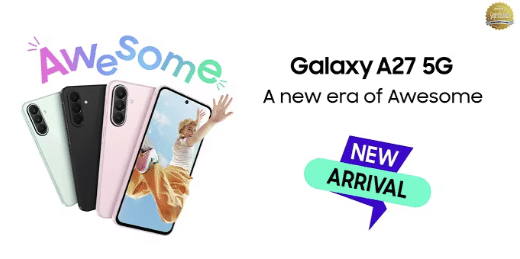
You don’t need flagship money here. The Samsung Galaxy A27 5G costs S$418, and its clean Infinity-O display is a clear step away from last year’s dated notch. Samsung’s six years of software support could matter even more over time, especially when several rivals at this price point don’t promise the same useful lifespan.
That long support window is important context for the rest of the phone. The A27 is not trying to win on every specification: its appeal is the combination of a modern display, steady mid-range performance, and a device lifespan that extends well beyond the usual upgrade cycle.
There are two storage choices. The base model should satisfy most users, while the 256GB version costs S$498. Released in July 2026, the phone still has two things to prove: whether it can outmatch nearby competitors and whether the Snapdragon 6 Gen 3 has enough headroom for everyday demands.
RWM Price for Samsung A27
So far, the answer looks encouraging. The Snapdragon 6 Gen 3 stays smooth in daily use, and the design no longer feels like a budget compromise. Buyers who value a notch-free Super AMOLED display and consistent mid-range performance over the latest camera features will find the S$418 Galaxy A27 5G an easy recommendation.
Samsung Galaxy A27 Pricing and Availability in Singapore
The Galaxy A27 5G starts at S$418 for the base 128GB model. That keeps it in mid-range territory, below many competing phones, and the price has remained unchanged across major channels since its local launch on July 3, 2026.
How much does the Galaxy A27 5G cost locally?
Authorized sellers list the 128GB version at S$418 and the 256GB model at S$498. These are standard non-promotional prices, so the S$80 difference buys you twice the internal storage rather than a temporary deal.
Value comparison: 128GB vs 256GB storage options
Cloud-storage users should find 128GB sufficient. If your phone routinely collects photos, videos, and apps, though, the 256GB version is the less fussy choice because it cuts down on regular file management. The extra cost is therefore less about performance than about postponing the point at which storage becomes a daily consideration.
Where to buy the Samsung A27 in Singapore right now
OnePhone Singapore currently stocks the phone and often carries both color options. You can also buy the Galaxy A27 5G from major electronics retailers and Samsung’s authorized dealers. It’s a current model, not a pre-order item.
Design Upgrades Over the Galaxy A26
The biggest visual change is easy to spot. Samsung has replaced the A26’s U-shaped, teardrop notch with a small centered punch-hole camera, so notifications and status icons get more breathing room.
Why the Infinity-O display matters for modern users
That switch gives the 6.7-inch Super AMOLED panel a less interrupted viewing area, which matters when a notch would sit over game controls or video content. Samsung calls the layout “Infinity-O.” The glass also looks cleaner and more expensive, bringing the A27 visually closer to the company’s flagship S-series phones than to its budget predecessors.
The benefit is not a dramatic change in what the screen can do. It is a quieter improvement: fewer compromises in the interface, and a front design that is less likely to make the phone feel dated before its software support runs out.
Ergonomics and build quality of the 2026 model
It is still a large phone. Yet the 6.7-inch footprint remains manageable in hand because the refined side rails add grip without making the chassis feel thick or awkward. Samsung has also moved away from last year’s glossy finish, and the new materials show fewer fingerprints.
That helps the phone look presentable through normal daily use.
In practical terms, the camera cutout frees up screen space that the A26’s teardrop notch occupied. The change is modest, but the interface feels cleaner and noticeably more current.
Performance Benchmarks with Snapdragon 6 Gen 3
The Snapdragon 6 Gen 3 makes a convincing difference. Instead of feeling like a basic daily driver, the A27 comes across as a genuinely responsive mid-range phone, largely because it wastes less energy while keeping routine performance smooth.
Real-world speed tests for daily apps and multitasking
Apps launch almost instantly. On older A-series models, white screens often lingered while the Exynos chips caught up, but that awkward pause is largely gone here.
Chrome can keep multiple tabs open while Instagram sits in the background, and switching between them feels snappy. Background processes no longer produce the stutter seen in previous A-series models, at least during ordinary multitasking.
Gaming capabilities on the new mid-range chipset
Casual games such as Candy Crush run smoothly. PUBG Mobile is a tougher test, yet standard matches hold around 45 to 50 fps at medium settings, which is steady enough for most players.
Intense firefights don’t cause major frame drops.
Loading screens are significantly shorter than on last year’s model.
Touch response remains accurate during rapid movements.
Thermal management during extended use
It stays warm, not hot.
After an hour of continuous gaming, the back panel never reaches the uncomfortable point where you’d need to put the phone down. That restrained temperature also shows up in less demanding tasks: you can stream videos or use maps for hours without noticing a significant rise near the camera module. Less wasted energy means less heat, though the benefit is most obvious over extended use rather than in a quick test.
That makes the chipset upgrade meaningful in a practical, rather than headline-focused, way. The A27 does not need to behave like a flagship; it needs to avoid turning routine use into a series of small delays, and it largely succeeds.
Camera Quality and Low-Light Performance
Megapixels aren’t the main story here. The 50MP sensor’s optical image stabilization (OIS) does more practical work, counteracting hand shake so the A27 can use a slower shutter speed without blurring the shot. You’ll notice that advantage most when daylight starts thinning out.
How OIS helps the 50MP main sensor
More light reaches the sensor. Because OIS lets the A27 hold the shutter open longer, the software doesn’t have to push ISO as aggressively, which helps avoid grainy noise. Shadows therefore look cleaner and fine details remain sharper in dim cafes and along evening streets.
Daylight vs night shots
Sunlight brings the usual Samsung saturation: greens look lush, and skies come out vibrant. Night mode is where the camera earns its keep. Highlights stay controlled rather than blowing out, while darker parts retain texture instead of collapsing into muddy black.
It still doesn’t have flagship-level dynamic range, but for S$418, the result is respectable.
Video stabilization and recording features
Walking footage remains watchable at 1080p or 4K. The stabilization removes much of that jittery amateur look, although it won’t replace a gimbal. One limitation shows up after dark: focus hunts slightly before locking on.
Cinematic bokeh isn’t on the menu either.
At a glance
Feature / Detail Samsung Galaxy A27 5G (2026) Singapore Launch Price S$418 for the 128GB variant; S$498 for the 256GB model. These are the current street prices at major retailers like OnePhone and authorized Samsung dealers. Key Upgrades vs. A26 The most visible change is the switch from a teardrop notch to a cleaner “Infinity-O” punch-hole display. Under the hood, it now runs on the Snapdragon 6 Gen 3 chipset, offering a noticeable bump in efficiency over last year’s hardware. Display & Battery You get a large 6.7-inch Super AMOLED panel with a smooth 120Hz refresh rate. Powering it is a 5,000mAh battery that supports 25W fast charging, solid for all-day use, though don’t expect flagship-level charging speeds. Software Longevity This is arguably the strongest selling point: Samsung commits to 6 years of Android OS and security updates. If you plan to keep your phone for half a decade, this support window makes the S$418 entry price feel much more reasonable.
Battery Life and Charging Speeds
Capacity hasn’t changed much: the 5,000mAh cell is familiar territory. Paired with the efficient Snapdragon 6 Gen 3, though, it delivers noticeably better endurance than that number suggests.
All-day endurance with the 5,000mAh cell
A full day of mixed use is easy. Stream heavily, scroll through social feeds, and there should still be enough charge left for the evening commute.
Standby drain stays low. After a quieter day, the phone won’t wake up dead by morning.
Power efficiency of the Super AMOLED panel
The 6.7-inch Super AMOLED display does some of the quiet work here. In dark mode, black pixels remain off, which trims power draw rather than lighting every part of the screen.
120Hz doesn’t undo that advantage. The panel remains relatively sparing with energy, helping the battery last longer than its capacity alone might suggest.
What to expect from 25W fast charging
Charging is the less impressive part. In 2026, a 25W limit feels conservative, and a full charge from zero takes roughly 90 minutes.
For most routines, a morning top-up is enough.
Give it 30 minutes and you’ll add about 40 percent battery.
There’s no compatible charger in the box, so you’ll need to supply your own.
This is the clearest reminder that the A27’s value comes from balance rather than outright specification leadership. Endurance is convincing, but buyers who prioritise very fast top-ups may find the 25W limit harder to overlook.
Long-Term Software Support Commitment
For a S$418 handset, Samsung’s six-year OS upgrade pledge is unusually ambitious. The A27 5G should remain current until at least 2032, nearly doubling the support window that has been common in this price bracket.
Breaking down the 6-year update promise
This isn’t limited to security fixes. The phone will also receive full Android version upgrades, so newer apps should remain compatible even after competing devices have stopped receiving support.
Most mid-range phones get two or three OS updates. Samsung’s longer policy changes the calculation for the A27 5G: a budget phone is less likely to feel obsolete after only a few years.
Why Android OS longevity matters for resale value
Current software usually helps a phone hold its second-hand value. If you replace the A27 5G in 2029 or 2030, it should still be a viable, secure choice for a student or a backup device, rather than heading straight to e-waste.
A longer usable lifespan lowers the annual cost of ownership.
Future banking and productivity apps are more likely to remain compatible.
It should retain more trade-in value than unsupported rivals.
That support can matter financially. Spread across more years, the original purchase price becomes easier to justify.
Security patch frequency and device safety
Major OS upgrades are only part of the picture. Regular monthly or quarterly security patches help address emerging threats, which becomes especially important when the phone is handed down to family members.
Five years in, the A27 5G can still receive protection against known vulnerabilities without requiring a hardware replacement. That won’t make the device new again, but it can keep an older phone safer and usable for considerably longer.
This is why the earlier design and performance improvements matter beyond first impressions. A cleaner front and smoother chipset make the phone easier to live with now; the update promise gives those improvements more time to remain relevant.
FAQ
How much does the Samsung Galaxy A27 5G cost in Singapore?
The Galaxy A27 5G launched on July 3, 2026, with a starting price of S$418 for the 128GB storage variant. If you need more space for photos or apps, the 256GB model retails for S$498. These are the standard official prices you will see at major electronics retailers and Samsung authorized dealers right now.
You can pick one up from OnePhone Singapore or other large local tech stores. Since it is a current model released just this year, stock is generally stable, though specific colorway availability might fluctuate depending on the retailer. It is positioned as a direct successor to the A26, so expect occasional bundle deals rather than deep hardware discounts this early in its lifecycle.
Is the Galaxy A27 a significant upgrade over the A26?
Honestly, the jump feels more substantial than usual for this series. The most obvious change is on the front: Samsung finally dropped the dated teardrop notch in favor of an “Infinity-O” punch-hole display. It makes the 6.7-inch Super AMOLED screen look much more modern and gives you slightly more usable screen real estate.
Under the hood, it runs on the Snapdragon 6 Gen 3 chipset. This is a solid mid-range processor that handles daily tasks and light gaming without the stuttering sometimes seen in older entry-level chips. Combined with a 120Hz refresh rate, the interface feels snappy.
If you are holding onto an A24 or A25, this refresh rate and design update alone might justify the switch.
Does it support long-term software updates?
Yes, and this is arguably its strongest selling point. Samsung commits to six years of Android OS and security updates for this device. That means your phone stays secure and receives new features well into the early 2030s, which is rare for a phone in this price bracket.
Most competitors in the sub-S$500 range offer only two or three years of major OS updates. By stretching that support to six years, Samsung effectively turns the A27 into a budget device you can actually keep for half a decade without feeling forced to upgrade due to software obsolescence. It changes how you calculate value over time.
How are the camera and battery life in real use?
The main camera uses a 50MP sensor with Optical Image Stabilization (OIS). OIS is important here because it helps keep shots sharp in low light and stabilizes video when your hands shake. It is not going to beat flagship night modes, but for daytime social media posts or quick snapshots of receipts and documents, it is perfectly reliable.
Battery life is solid thanks to a 5,000mAh cell that easily lasts a full day of mixed use. However, charging speed caps at 25W. While it gets you back to full power eventually, it feels slow compared to Chinese rivals offering 67W or higher in similar price ranges.
You will want to plug it in overnight rather than expecting a quick top-up during lunch.
Conclusion
At S$418, the Galaxy A27 5G feels well judged for Singapore’s mid-range market. The AMOLED display is polished, and the cleaner design adds appeal, particularly if a generous screen matters more to you than top-end processing speed. For everyday use, it’s a dependable pick.
Check OnePhone or local authorized dealers for the storage tier that suits you.
The tradeoff is straightforward: charging speed and camera ambition are limited, while the display, performance, battery endurance, and six-year support policy are unusually well aligned for the price. Buyers who want a phone to keep for several years have a stronger reason to choose the A27 than those simply chasing the fastest hardware today.
Table of Contents