
The key comparison is therefore total cost: how the waived upfront fee changes the contract, and how it compares with buying the phone outright.
The Verdict: Who Should Commit to M1’s iPhone 18 Pro Contract?
M1’s 36-month contract is easiest to justify for heavy data users who regularly approach the included 100GB allowance. For lighter users, the bundle’s apparent convenience can obscure a simple tradeoff: unused data and storage still form part of the monthly commitment.
Why the Pro Max bundle favors power users over casual upgraders
The iPhone 18 Pro Max uses significant bandwidth for ProRes video workflows and always-on satellite connectivity. M1’s highest-tier plan is built around that kind of usage, waiving the device’s upfront fee in exchange for a long-term service commitment.
- Heavy cloud backup users get the included 2TB iCloud+ tier, which normally costs a separate monthly subscription.
- Frequent international travelers get unlimited roaming passes, available only with the Pro Max contract.
- Content creators can offset the higher monthly bill by avoiding third-party storage and data top-ups.
That list describes a specific user rather than a typical upgrader. If you do not transfer large files daily or use hotspot tethering constantly, much of the bundle may go unused. The plan makes sense only when those services are part of your regular usage, not merely features you might use later.
When keeping your current device makes more financial sense
Owners of an iPhone 15 Pro or newer are unlikely to see enough improvement in everyday tasks to justify a new contract. The camera upgrades and modest battery gains do not offset the total cost over three years.
- Avoid signing if your current battery health is above 85 percent. Replacing the battery costs far less than taking on a new plan.
- Skip the upgrade if you do not need the A20 chip’s specific AI processing capabilities for local tasks.
- Consider waiting if you prefer to buy outright. Early termination penalties remain steep in 2026.
Keeping the current phone is usually the more flexible choice until software support ends or a serious hardware failure occurs. For most people, the iPhone 18 Pro is a lateral move rather than a necessary upgrade, and that makes the 36-month commitment harder to defend.
Comparing M1 Bespoke Flexi Plans for iPhone 18 Pro Models
Securing the latest Apple flagship often comes down to balancing monthly cash flow against the total cost of ownership. With the iPhone 18 Pro and Pro Max, M1’s Bespoke Flexi plans offer a specific structure that removes the initial barrier to entry while tying your long-term commitment to the device’s higher tier.
Analyzing the $0 upfront advantage
The $0 upfront model is a calculated shift by M1 to make premium hardware feel more accessible, though it shifts the cost into your monthly subscription bill. By choosing this route, you avoid a heavy lump-sum payment at the point of sale, which is often the biggest hurdle when upgrading to a Pro-level device.
For many buyers, this structure represents a psychological shift as much as a financial one. Rather than parting with a significant sum of cash all at once, you exchange that immediate hit for a predictable, albeit higher, recurring expense. It is a classic trade-off: liquidity today in exchange for a longer financial tail tomorrow.
- Immediate possession: You walk out of the store with the device without paying the retail price, provided you meet the credit requirements for the Bespoke Flexi contract.
- Monthly burden: Because the device cost is amortized over the contract duration, your monthly bill will be higher than if you had purchased the handset outright or made a payment.
- Financial flexibility: This model is designed for people who prefer to keep their cash reserves intact for other expenses, turning the phone purchase into an installment plan managed through your telco bill.
- Credit assessment: M1 determines your eligibility for the $0 upfront option based on your current account standing and credit profile, so it is not guaranteed for every applicant.
Key differences between Pro and Pro Max contract terms
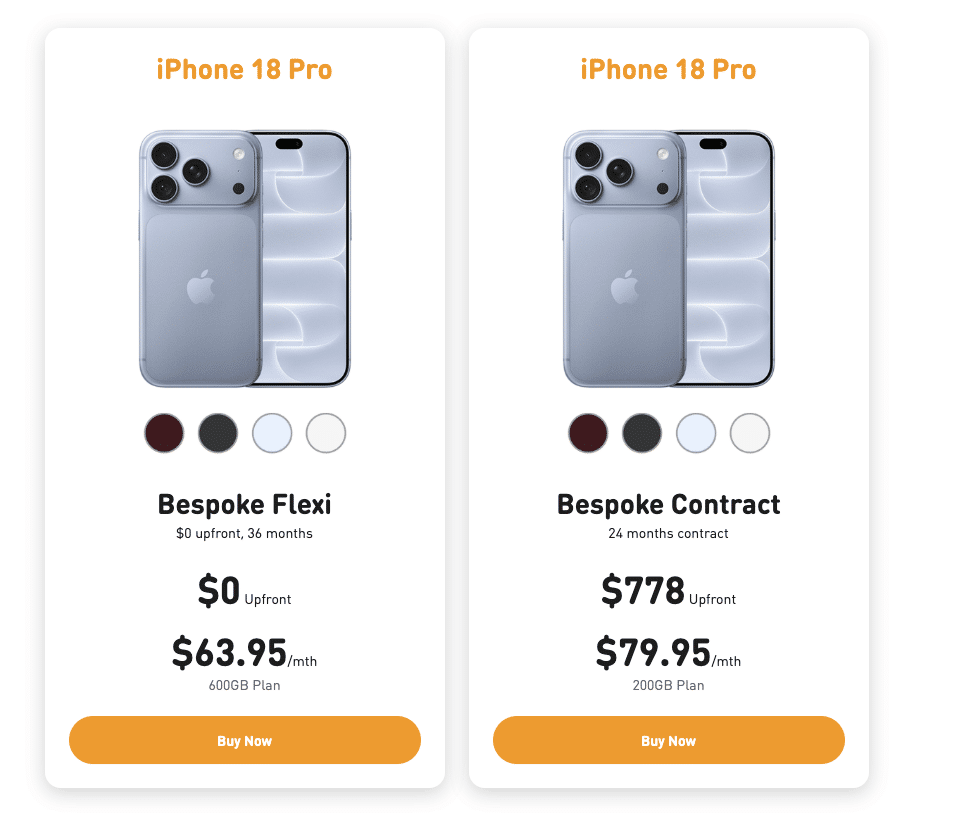
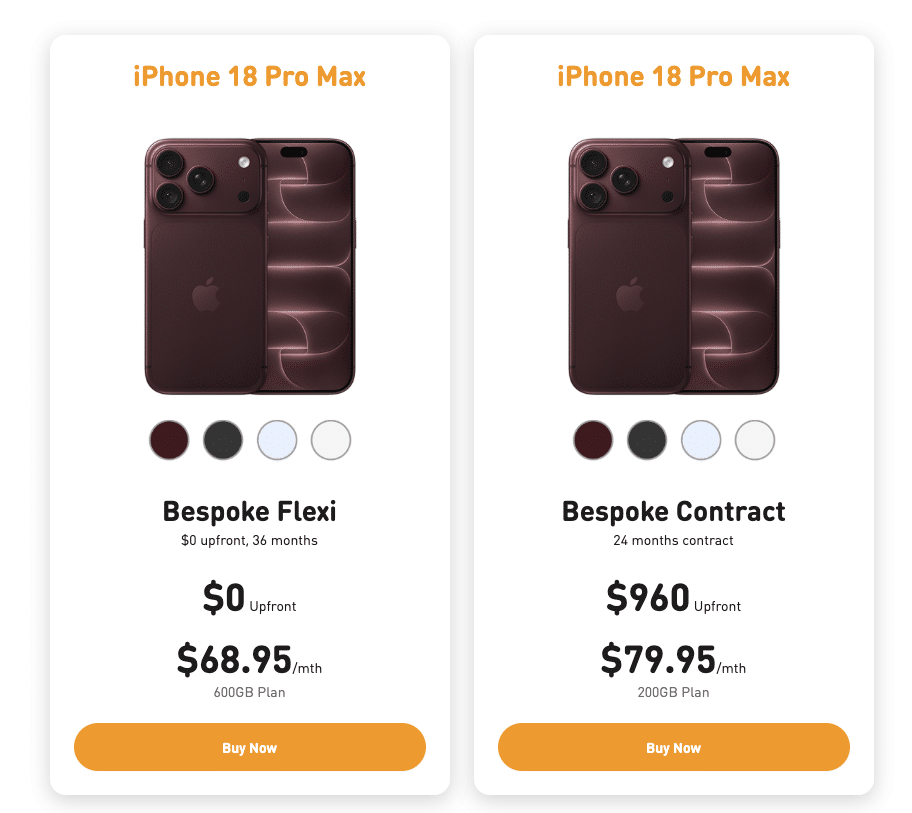
While both the iPhone 18 Pro and Pro Max are eligible for the Bespoke Flexi plan, the underlying math changes based on the model you select. The higher retail price of the Pro Max translates to a higher monthly device installment, which can influence which base plan you choose to pair with it.
Consider how this installment gap accumulates over 24 months. While a difference of ten or fifteen dollars a month seems negligible on a single billing statement, it compounds over the two-year lock-in period. That extra margin could otherwise cover a premium data add-on or a roaming subscription.
If you choose the Pro Max, you are choosing to prioritize screen real estate over that potential plan flexibility.
- Installment scaling: The monthly device fee for the Pro Max is higher than the Pro, reflecting the price gap between the two handsets.
- Base plan compatibility: While M1 allows you to pair these devices with various data tiers, opting for the Pro Max often makes more sense if you are already looking at higher-tier data plans to use the larger display for streaming and productivity.
- Contract lock-in: Both models require the same commitment period, but the total value of your contract will be higher for the Pro Max.
- Resale vs. value: If you plan to upgrade annually, consider whether the higher monthly commitment for the Pro Max provides a better return in trade-in value compared to the Pro, or if the standard Pro model offers a more efficient cost-per-month ratio for your specific usage.
If you are weighing these costs, comparing the total contract value against the current market price at Red White Mobile is a smart move. While the telco plan offers convenience, purchasing outright or through flexible retail options can sometimes result in a lower total cost of ownership over two years. Always check if the monthly savings on a SIM-only plan, when paired with a standalone device purchase, outweigh the convenience of an M1 device bundle.
Understanding the 2026 iPhone 18 Pro Lineup and M1 Variants
The 6.3-inch Pro weighs 198 grams, compared with 221 grams for the Pro Max. That 23-gram difference can make the smaller phone easier to carry every day.
Differences between the Pro and Pro Max hardware specifications
Both devices use the A20 Bionic chip and the new tetraprism zoom lens, so their computational photography and gaming performance are the same. The meaningful differences are battery life and screen size. The Pro Max has a larger battery and delivers roughly three more hours of screen-on time under heavy 5G use than the Pro.
- Pro: 6.3-inch Super Retina XDR display, better suited to one-handed typing.
- Pro Max: 6.9-inch display, with more room for split-screen multitasking and media.
- Thermal management: The larger chassis dissipates heat more effectively during sustained 4K video recording.
Choose the Pro for easier handling. Choose the Pro Max if battery life is the main reason for upgrading. The larger model’s advantages are practical, but they do not by themselves make the contract better value.
How M1 structures its device tiers and storage options
M1 matches its plan pricing to Apple’s storage tiers, avoiding complicated mid-range SKUs that make total costs harder to calculate. The carrier does not offer exclusive colors or modified hardware. Customers get the standard global models.
- 256GB: The entry point for M1’s subsidized contract rates.
- 512GB: Aimed at prosumers who edit video on the device, with a moderate monthly surcharge.
- 1TB: Intended for heavy workflows, with the highest upfront device valuation in the installment schedule.
These storage tiers should not be confused with the plan’s included cloud allowance. M1 does not include extra cloud storage with the hardware tiers. Some competitors bundle 2TB of iCloud space with higher-end plans, but M1 charges only for physical storage.
That simplifies the device comparison, while heavy data users still need to budget separately for cloud backups once they exceed the phone’s local capacity.
At a glance on M1 Plans for iPhone 18 Pro and iPhone 18 Pro Max
| Plan feature or bundle inclusion | Who actually benefits from it |
|---|---|
| Included 100GB monthly data allowance and unlimited roaming passes | Frequent international travelers and heavy hotspot tethering users who would otherwise pay for separate data top-ups |
| Bundled 2TB iCloud+ storage tier and waived upfront device fee | Content creators managing ProRes video workflows and large cloud backups who want to avoid third-party storage subscriptions |
| A20 chip AI processing capabilities and modest camera upgrades | Users whose current iPhone battery health is below 85 percent or who specifically need local AI tasks that older chips cannot handle efficiently |
Is the Monthly Installment Plan Actually Cheaper Than Buying Outright?
Subtracting the device subsidy from M1’s monthly bill reveals the central issue: the plan charges for convenience rather than necessarily reducing ownership cost. The advertised “zero upfront” offer comes with higher recurring line rental fees, which can increase the total over three years.
Comparing total ownership costs with SIM-only deals
- SIM-only deals on M1’s 5G network typically cost half as much as bundled contract rates.
The gap grows for users who already own a compatible eSIM or want to switch carriers for better roaming rates. A single-provider contract removes that flexibility while adding a premium for hardware financing. This is why the usage test matters: the included services need to compensate for the flexibility being given up.
The hidden impact of early termination fees on long-term value
M1’s 36-month commitment carries steep penalties for users who upgrade early or leave Singapore. The remaining device balance becomes due immediately, often wiping out any monthly savings from the first part of the contract.
- Bundled tiers do not provide pro-rated refunds for unused service months.
- The iPhone’s resale value can fall faster than the contract amortization schedule.
If you expect to upgrade within two years, buying outright preserves the device’s resale value and your flexibility. You can sell or trade in the phone without carrier restrictions or an outstanding balance on your credit profile. That flexibility is difficult to price in advance, but it becomes important as soon as your circumstances change.
How Does the iPhone 18 Pro Perform on M1’s 5G Network?
Peak throughput on M1’s standalone 5G network frequently reaches 800 Mbps in the Central Business District. Real-world consistency, though, depends more on building penetration than on distance from the tower.
Evaluating real-world speeds and latency in urban Singapore
Sub-6GHz bands provide reliable coverage across HDB estates and underground MRT stations, so video calls and cloud backups remain stable even when the signal bars drop. In dense areas such as Tampines and Jurong East, average download speeds range from 150 Mbps to 300 Mbps during peak evening hours. That is enough for 4K streaming, though it falls behind the mmWave speeds available in select commercial hubs.
Latency averages 12 to 18 milliseconds for local servers, which keeps cloud gaming and real-time collaboration responsive. International routing can add jitter, especially when accessing content hosted outside Southeast Asia. M1’s network prioritization policies may throttle heavy data users during congestion, so file transfer rates can fluctuate even when speed tests look impressive.
- Consistent sub-20ms latency for local gaming servers
- Variable international routing speeds during peak usage
Battery drain implications of sustained 5G connectivity
The iPhone 18 Pro’s A20 Bionic chip manages power more efficiently than previous generations, but a constant 5G connection still uses significantly more energy than LTE. During mixed use, including navigation, social media scrolling, and video playback, users can expect the battery to deplete 15 to 20 percent faster than it would on Wi-Fi or 4G alone.
M1’s network slicing features help by allowing the device to switch to low-power idle states when data demand drops. In areas with weak 5G signals, however, the modem has to work harder to maintain the connection, which generates heat and speeds up battery drain. Heavy users should consider enabling “5G Auto” in settings so the iPhone can choose when high-speed data is needed.
- Moderate heat generation during large file downloads
- Negligible impact when connected to stable Wi-Fi
FAQ
Does M1 charge an early termination fee if I leave before the 36 months end?
Yes, M1 imposes steep early termination penalties for breaking the 36-month contract early. You typically pay the remaining subsidized device cost plus part of the waived service fees. Depending on how many months remain, that can amount to hundreds of dollars.
Leaving the plan becomes expensive if your usage drops or you switch carriers mid-contract.
Before signing, calculate the total cost of ownership, including the potential penalty. If you might upgrade again in two years or move overseas, the locked-in nature of the deal could become a liability. Check the specific termination clause in your final contract draft, since marketing materials do not always highlight these figures.
Can I keep my existing phone number when switching to an M1 iPhone 18 Pro plan?
Yes, M1 supports mobile number portability, so you can retain your current Singaporean phone number when switching from another carrier. You do not need to close your old account first. Provide your current provider’s account details and authorization code during the M1 sign-up process.
Porting usually takes one working day, so calls and texts should face minimal downtime.
Make sure your old account is active and free of outstanding bills before starting the transfer. Rejections often result from administrative holds rather than technical issues. Keep your old SIM card inserted until M1 confirms that the number has moved to the new M1 SIM, so you do not miss critical verification codes during the switch.
Is the 2TB iCloud+ storage included forever or just for the contract duration?
The 1TB iCloud+ subscription is included only for the 36-month contract period. After the contract ends, M1 stops subsidizing the tier, and Apple will charge you the standard monthly rate for 2TB storage unless you downgrade or cancel it. Many users miss this detail and face a higher bill after their three-year term expires.
Set a calendar reminder for one month before the contract ends and review your storage usage. If you do not need 2TB, downgrade through your Apple ID settings to avoid paying for unused space. If you do need it, include the standalone subscription cost in your post-contract monthly budget.
Does M1 offer trade-in credits that stack with the iPhone 18 Pro contract discount?
M1 generally does not allow trade-in credits to stack with its maximum contract subsidies. You must choose between a lower upfront device cost through a trade-in and a fully waived upfront fee through a long-term plan. Combining the two often leads to smaller monthly bill waivers or a higher effective device price.
The better option depends on whether you want a lower monthly cost or a lower total cost over the contract.
If your current device has a high resale value, selling it privately and using the money to offset a shorter contract might provide better returns than trading it in through M1. Compare M1’s official trade-in valuation with third-party buyback services before deciding. For recent models such as the iPhone 15 Pro, private sales often provide significantly more money than carrier trade-ins.
Conclusion
M1’s iPhone 18 Pro plans suit a narrow group of users rather than everyone. They make sense if you regularly use the full 100GB data allowance and need the included iCloud storage. With moderate usage, the three-year lock-in can cost more than buying the handset outright, while the 2TB benefit also ends with the contract.
Check your current data and storage needs, then compare the full 36-month cost before signing anything.
Check out also iPhone 18 Pro and Pro Max Singtel Price Plans
Table of Contents