The Huawei Mate 90 series hit shelves in China on October 1, 2026, with major updates to its display and camera hardware. The Kirin 9050 Pro chip drives a brighter panel with tighter color accuracy, while the updated XMAGE system reduces low-light noise and sharpens portrait edges. For anyone considering an upgrade from the previous model, the clearest changes show up in power efficiency and camera modularity.
The breakdown below details the LogicFolding architecture, peak brightness metrics, and how the modular XMAGE Z10 lens attaches to the Pro Max model.
The Huawei Mate 90 series focuses on battery life and camera performance, built around the Kirin 9050 Pro chip and a brighter screen. Low-light photos look noticeably cleaner, and the Pro Max includes a modular Ruiying Z10 lens that snaps on in less than ten seconds. You’ll carry a slightly heavier phone, but you get better battery life and sharper portraits in return.
What are the core upgrades in the Mate 90 series?
The Kirin 9050 Pro chip anchors the Mate 90 series, cutting power draw across Huawei’s flagship line.
LogicFolding architecture and Kirin 9050 Pro performance
The new LogicFolding architecture changes how transistors are packed, letting the Kirin 9050 Pro handle complex tasks on less power. That extra efficiency lengthens battery life without requiring a thicker phone. Daily tasks like browsing or video calls feel responsive, and heavy games run with fewer frame drops because of better heat dissipation built right into the silicon layout.
Benchmark-setting brightness and color reproduction
Peak brightness on this panel makes the screen easy to read in direct sunlight. Colors lean toward accurate tone matching rather than heavy saturation, so photos look true to life. An adaptive refresh rate drops the panel speed on static images to save power, balancing visual quality with battery drain.
Evolution of the XMAGE imaging system
Upgrades to the XMAGE imaging system cut image noise in low light while holding onto fine detail. Rewritten algorithms preserve shadow and highlight detail in bright scenes, and portrait mode creates cleaner subject separation along hair and clothing edges.
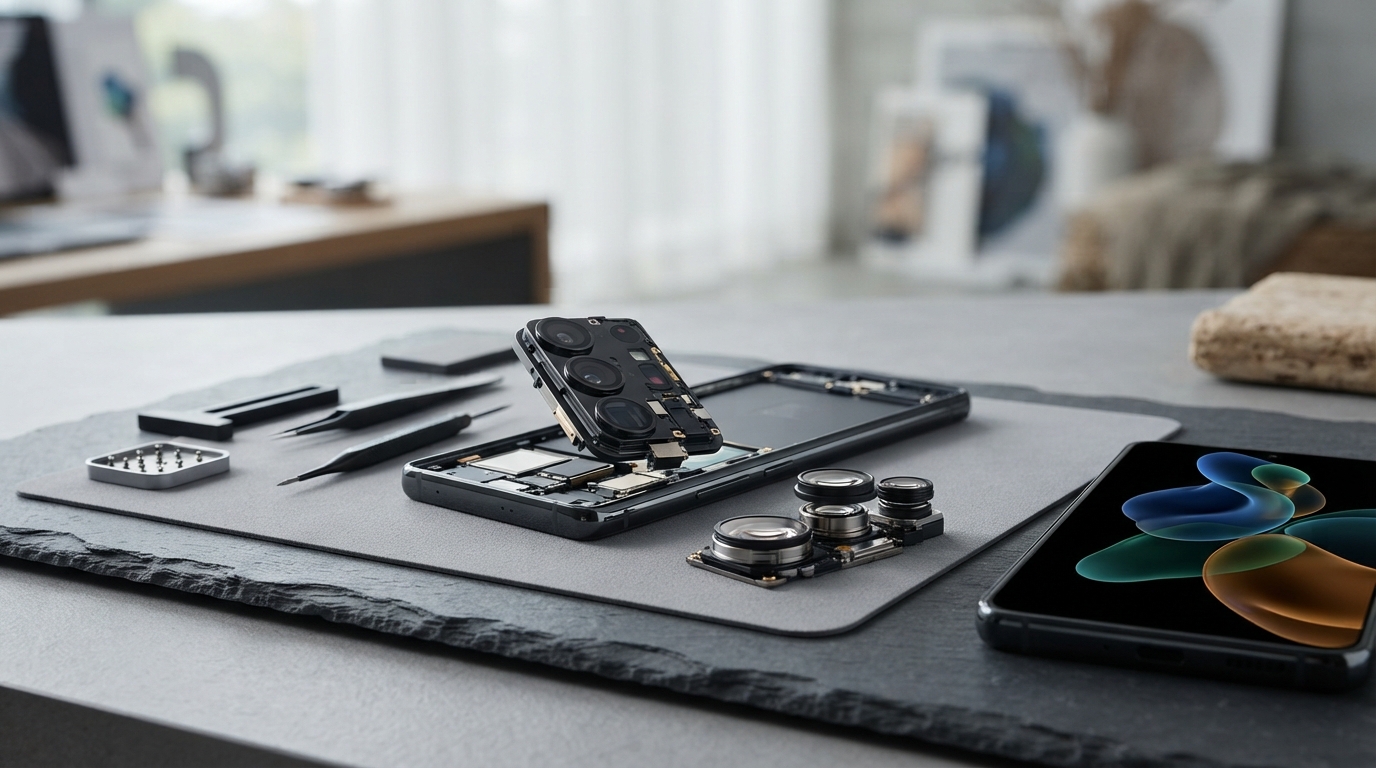
How the modular camera system functions
How the Z10 attaches
The accessory relies on a proprietary magnetic rail system that locks the glass directly over the phone’s camera module. It connects without tools, so you can swap the lens in under ten seconds without scratching the main glass or damaging internal sensors.
- A rubber ring cushions the impact during daily handling.
- The lens keeps full autofocus capability once attached.
Hardware compatibility
This setup does not work across the entire Mate 90 line. The base Mate 90 and Mate 90 Pro lack the internal rail hardware, which limits the Z10 to the Pro Max and RS Ultimate Design tiers. Huawei skipped the rail on lower-end models to keep their bezels thin.
Handling and trade-offs
Adding the Z10 shifts the phone’s center of gravity toward the top, which feels heavy during one-handed use. That extra weight does offer a slight advantage, though: it helps steady the phone for long-exposure shots.
You lose some pocket space for extra optical reach. The lens extends focal range beyond the built-in telephoto camera and pulls in cleaner detail in low light. It trades the slim profile of the unadorned phone for better hardware capability.
What does the new display technology look like in practice?
12,000 nits sounds like an absurd marketing figure, but it actually fixes outdoor legibility. On the Mate 90 series, that local peak brightness changes what happens when you use the screen in full sunlight.
Navigating the 12,000-nit local peak brightness
The 12,000-nit spec applies to small elements like text and icons, not the entire panel. It keeps critical details readable without you having to shade the screen with your hand. By pushing light only to specific pixels, the display keeps shadows dark and avoids draining the battery like a uniformly blasted panel would.
Full-chain BT.2020 color support for creators
Full-chain BT.2020 coverage gives video editors and photographers direct visual accuracy. The space goes well beyond sRGB to show deep blues and saturated greens that usually get clipped or compressed. Hardware-level handling means you avoid software lag or color banding when swapping profiles, which makes the phone accurate enough to double as a reference monitor for quick edits before exporting.
Real-world visibility under direct sunlight
Direct sunlight usually ruins OLED displays. The Mate 90 handles it by driving up light output in bright areas while holding contrast steady in the shadows. Maps, text messages, and navigation prompts stay sharp at noon in Singapore.
An anti-reflective coating cuts down surface glare alongside the brightness boost, so you do not have to twist the phone around just to read a single sentence.
At a glance
| Model | Starting Price (RMB) | Key Camera & Display Feature |
|---|---|---|
| Mate 90 | 5,999 | Base display with adaptive refresh rate |
| Mate 90 Pro | 6,999 | Upgraded XMAGE imaging system |
| Mate 90 Pro Max | 9,499 | Compatible with Ruiying Z10 modular lens |
| Mate 90 RS Ultimate Design | 12,999 | Compatible with Ruiying Z10 modular lens |
FAQ
What is the actual peak brightness on the Mate 90 display?
The 12,000-nit figure you see in marketing materials applies only to a 1% local peak area of the screen, not the entire panel. When you look at full-screen brightness, the number drops to approximately 2,200 nits. This distinction matters if you plan to use the phone outdoors for extended periods, as the full-screen value is what you will actually see during typical video playback or web browsing.
Which models support the Ruiying Z10 modular camera?
The 1-inch Ruiying Z10 lens is compatible only with the Mate 90 Pro Max and the Mate 90 RS Ultimate Design. You cannot attach it to the standard Mate 90 Pro or the base Mate 90 model. The system relies on a proprietary magnetic rail that locks the glass directly over the camera module, so the physical dimensions and mounting points on the lower-tier models simply do not align with the accessory.
How does HarmonyOS 7.0 affect app availability outside China?
Running HarmonyOS 7.0 means you will likely encounter limited app compatibility if you are using the device outside of China. The system does not include Google Mobile Services (GMS) by default, which can be a significant hurdle for users accustomed to the standard Android ecosystem or iOS. While Huawei has been improving its own app store, the selection and performance of specific international applications may still vary compared to what you would find on a standard Android device.
What is the total weight of the phone with the Z10 camera attached?
The combined mass makes the device feel quite substantial in your hand, especially if you are used to lighter flagship phones without modular attachments.
Conclusion
Huawei hasn’t announced local pricing or a specific launch date yet. Check their official channels as the release window gets closer.